
Bouncy castle safety comes down to five things: constant supervision, limited numbers, an on-site wind check, proper anchoring, and an undamaged unit. UK guidance sets the wind ceiling at 38 km/h. UAE winds can pass that on an ordinary dusty day.
Quick answer: Supervise constantly, follow the unit’s user limit, keep small and large children apart, stop at 38 km/h wind or the manufacturer’s lower limit, anchor every point, and inspect before anyone gets on. Selected Book A Bouncy rides include an operator or attendant.
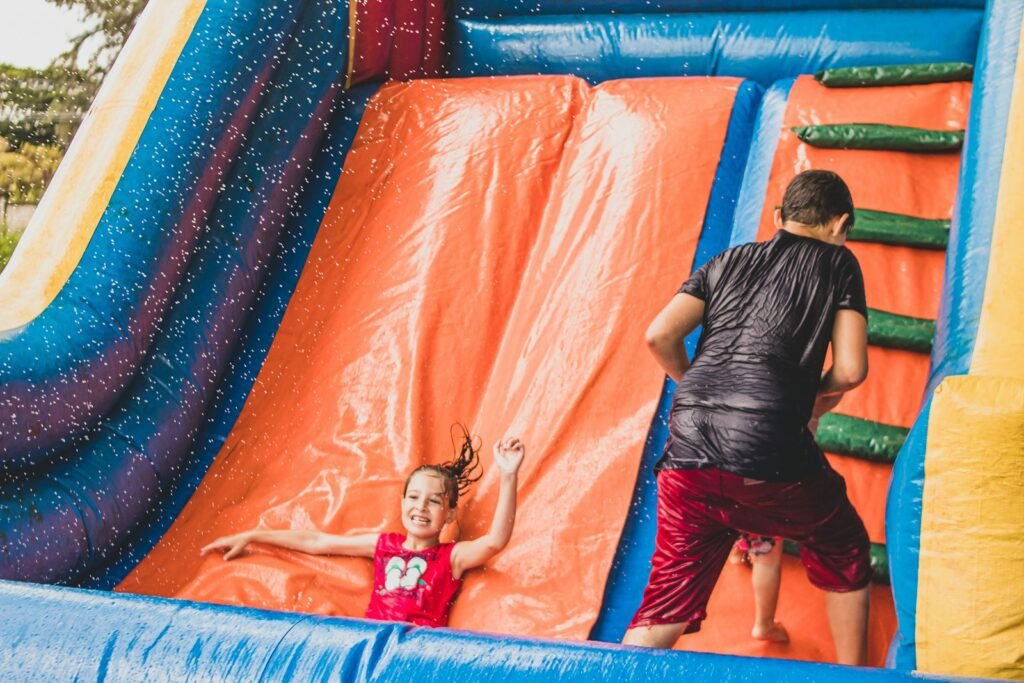
Short answer: what are the main bouncy castle safety rules?
The core rules are in the table below. They come from the UK Health and Safety Executive’s guidance on play inflatables. It applies to equipment built to the European standard for inflatable play equipment.
| Rule | Why it matters | Source |
|---|---|---|
| Constant supervision by at least one trained person | Most injuries come from falls and collisions | HSE; Pediatrics study |
| Stay within the user limit on the unit label or manual | Overcrowding drives collisions | HSE |
| Keep larger users apart from smaller ones | Size mismatch causes injuries | HSE |
| Stop at 24 mph (38 km/h) or the unit’s lower limit | Wind can lift or tip the unit | HSE |
| Use every anchor point, at least six | Wind must not get underneath | HSE |
| Pre-use check: rips, seams, shape, pressure, blower | Faults show before anyone is hurt | HSE |
| No shoes, glasses or sharp items; no climbing walls | Reduces cuts, punctures and falls | HSE |
The risk is real. A 2012 Pediatrics study, reported by EurekAlert from Nationwide Children’s Hospital, found US emergency visits for child bouncer injuries rose 15-fold from 1995 to 2010.
Falls caused 43%. Fractures and sprains were most common. So supervision and group rules matter most.
What the operator does on site
Selected Book A Bouncy rides include an operator or attendant. In general terms, they check the area, anchor, inflate and check the unit. They supervise bouncing, watch the weather, and deflate if conditions change. You still supervise your guests, but you do not run the equipment.
HSE expects “constant supervision” by at least one suitably trained person whenever an inflatable is in use. That person enforces the user limit, keeps sizes apart, and watches anchors and wind.
Who does what:
- Our side: the equipment, the setup, the pre-use checks, operating the unit and the decision to stop it.
- Your side: your guests. Tell children the rules, keep food and drinks away, and help when a child will not come off.
- Shared: a worried parent speaks to the operator straight away. The operator’s call to pause or stop is final.
Planning a school event? Our page on school event rentals in Dubai covers how we plan larger groups.
Want to check something before you book? Send your venue and guest ages on WhatsApp +971 50 165 8883 or call +971 50 165 8883. We will tell you what fits safely.
Age and group mixing: how many children at once?
Follow the user limit on the unit label or manual, never more. HSE also says respect any height limit and keep larger users apart from smaller ones. Toddlers and teenagers should never share the unit at the same time.
The European standard BS EN 14960-1:2019 covers inflatable play equipment for bouncing and sliding. It is intended for children aged 14 and under.
The Pediatrics authors went further, until national guidelines exist:
- One child at a time where possible.
- Adult supervision throughout.
- Same age and size if several children bounce together.
- Use limited to children aged 6 and over.
Many UAE families hire for younger children too. So run separate sessions: little ones together, older ones together, never mixed.
Each unit has its own label, so we publish no single capacity or age band. We confirm the exact figures for your unit when you send the details. See party ideas by age, and for adults, can adults use bouncy castles.
Worked example: planning turns (generic numbers)
These numbers are an illustration only, not the limit for any Book A Bouncy unit.
| Input | Example value |
|---|---|
| Children at the party | 30 |
| User limit on the unit label | 8 |
| Groups needed (30 / 8, rounded up) | 4 |
| Length of one turn | 5 minutes |
| Time for every group to have one turn | 4 x 5 = 20 minutes |
| Turns per child in a 2-hour slot (120 / 20) | about 6 |
Split by size, not just headcount. If 10 of the 30 are under five, they form their own group.
Wind and weather limits: what wind is too strong?
UK HSE guidance says no inflatable should be used in winds above 24 mph (38 km/h), Beaufort Force 5. If the manual sets a lower limit, that limit wins.
Measure wind on site with an anemometer at regular intervals, not a phone weather app, which does not reflect local conditions. Without a wind meter, the inflatable should not be used outdoors. The HSE bouncy castle safety advice says to deflate safely if conditions become unsuitable.
Why this matters more in the UAE
Strong gusts are not rare here. A National Center of Meteorology forecast for 20 to 24 May 2026, reported via WAM, showed winds of 10 to 25 km/h.
They reached 40 km/h on four of the five days, with blowing dust. So a calm afternoon can pass 38 km/h for short spells. Garden walls, open fields, rooftops and beaches all change ground-level wind.
| What the on-site reading shows | What it means |
|---|---|
| Comfortably below the unit’s limit, steady | Bounce as normal, keep checking at intervals |
| Gusts creeping towards the limit, dust picking up | Fewer users, closer watch, be ready to clear the unit |
| At or above the unit’s limit (38 km/h at most) | Clear users and deflate safely |
| Blowing dust with poor visibility | Treat as unsafe even if the reading is lower; children cannot see and the operator cannot see them |
Limits differ by item, so we publish no single wind figure. We confirm the operating limit for your unit when you send the details.
Heat is the other UAE factor. Surfaces warm up and children tire fast. Plan shade, water and shorter turns, or use the cooler part of the day.
If rain, strong wind or extreme heat stops the event, we move the booking to a new date at no extra cost. Our refund and returns policy has the full terms.
Unsure about the forecast? WhatsApp +971 50 165 8883 or call +971 50 165 8883.
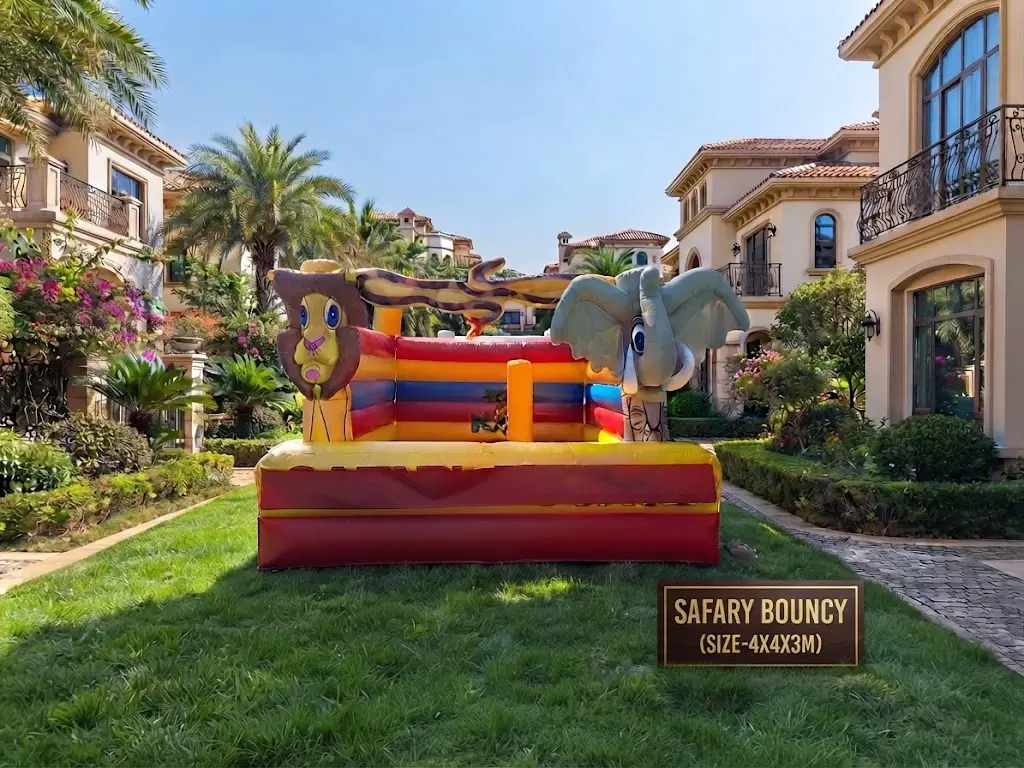
Anchoring and inspection: how is a bouncy castle secured?
Outdoors, use every anchor point, at least six. On grass, HSE calls for metal stakes at least 380 mm long and 16 mm wide. Where stakes cannot go in, it calls for at least 163 kg of ballast per anchor point.
Tie the unit tight so wind cannot get underneath. That is why we ask about your surface: interlock, a school field and an indoor hall each need a different approach.
- Indoors, anchorage follows the manufacturer’s manual.
- On hard standing, HSE expects impact-absorbing material around the unit, unless it is fully enclosed.
- Ropes must be in good condition. Makeshift ties such as bungee cord are not acceptable.
What gets checked before anyone bounces
HSE lists checks for every setup:
- The correct blower is fitted and firmly attached to the connection tube.
- No anchor point has pulled out, and nothing is over-tensioned or sagging.
- No holes, rips or seam damage.
- The unit stands symmetrically; a misshapen unit is not used.
- Internal pressure is within the manufacturer’s range.
- Entrance mats are in place, no more than 50 mm thick.
- A deflation test: with the blower off, the unit should go down slowly enough for children to get off safely.
Check blowers daily for debris and a working non-return flap. HSE expects a new unit tested against BS EN 14960, then inspected by a competent person every year.
Standards in plain words
- BS EN 14960-1:2019: the European standard for inflatable play equipment where the main activity is bouncing or sliding. It replaced the 2013 version.
- ASTM F2374: the US standard practice for inflatable amusement devices. It covers design, manufacture, installation, operation, maintenance, inspection and training for commercial units, including at schools and temporary events.
- PIPA and ADIPS: UK inspection schemes HSE points to for checking a unit’s test status in the UK.
Book A Bouncy equipment is CE-certified for covered items, and we hold public liability insurance. Whoever you book with, ask what applies to your exact unit.
Food, shoes and spills on the day
- Keep food, drinks, sweets and face paint off the unit. Crumbs and sticky hands attract ants and stain the vinyl.
- Shoes come off at the mat, not on the bed.
- Put the snack table well away from the entrance.
- Report spills or a sick child straight away, so the unit can be cleared.
Water slides combine wet surfaces with sliding. See our water slides and water games and ask about setup on your surface.
What parents should do: rules to share with children
Keep watching, even with an operator present. Brief children first, keep sizes separate, and pull a child off at the first sign of rough play. Hair clips and jewellery come off too.
A rules card, based on the HSE and Pediatrics guidance above:
- Shoes, glasses and sharp items off. Pockets empty.
- No food, drink or gum on the unit.
- No flips, somersaults, wrestling or climbing the walls.
- Small children and big children take separate turns.
- Stay within the number the operator allows.
- Get off when the operator says, no arguments.
- Adults stay off children’s units unless the operator says the unit allows it.
Before you book: what to send us
Send these on WhatsApp:
- Venue type: villa garden, school field, indoor hall, community park, hotel lawn
- Surface: grass, sand, interlock, tarmac, indoor floor
- Rough space available and photos of it
- Access route for the unit, including gates and stairs
- Power point location
- Number of children and their age range
- Event date and time of day
See space and power for a bouncy castle. For schools, read school fun day ideas.
When a bouncy castle is the wrong choice
Sometimes the safe answer is a different activity. One unit may not suit toddlers and teenagers if you cannot keep sizes apart. If the only space is a slope or balcony, or the venue is exposed on a gusty day, a ground-level game may be safer.
When we may suggest an alternative:
- Very young children only: a smaller, enclosed unit, or soft play rather than a large slide.
- Hot afternoon in summer: move the slot to the evening or choose a water attraction suited to the venue.
- Hard paving with no room for ballast or matting: interactive games instead of a bounce unit.
- Expected dust or high wind: an indoor venue, or a new date. Our rental FAQs answer the common follow-up questions.
See our bouncy castles range. Our corporate family day rentals page explains how mixed-age events are split.
Ready to plan? Send your date, venue and guest ages through our booking form, WhatsApp +971 50 165 8883 or call +971 50 165 8883, or email info@bookabouncy.ae.
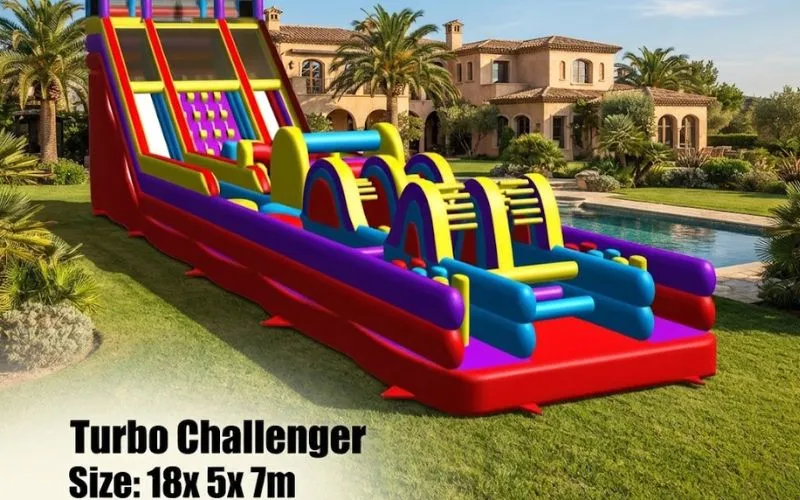
Frequently asked questions
Is an operator included with a bouncy castle booking?
For selected rides, yes. On those bookings an operator or attendant from Book A Bouncy checks and runs the equipment, supervises bouncing and decides when to pause or stop. Ask when you book whether your item includes one. Parents and teachers still look after their own guests, brief children on the rules and keep food and drinks away from the unit.
What wind speed is too strong for a bouncy castle?
UK HSE guidance sets the ceiling at 24 mph (38 km/h), Beaufort Force 5, and some units have a lower limit in their manual. Measure wind on site with an anemometer, not a phone app. UAE forecasts can show gusts of 40 km/h, so readings continue during the event, not only at setup.
How many children can use a bouncy castle at the same time?
The user limit on the unit’s label or in the manufacturer’s manual, and it differs between units. Children bouncing together should be a similar size, and large groups take timed turns split by size. We confirm the exact figure for your unit when you send your details.
Can toddlers and older children bounce together?
No. HSE guidance says larger users must be kept apart from smaller ones, and paediatric researchers advise grouping children of similar age and size. Run separate sessions, and if one unit cannot be shared safely, ask us about a second, smaller attraction.
What happens if the weather is unsafe on the day?
If rain, strong wind or extreme heat stops the event, Book A Bouncy moves your booking to a new date at no extra cost. The operator can also pause or deflate the unit during the event if conditions change. Full cancellation and refund terms are on our refund and returns policy page.
Sources
- Guidance on play inflatables (hse.gov.uk)
- HSE bouncy castle safety advice (hse.gov.uk)
- BS EN 14960-1:2019 (knowledge.bsigroup.com)
- Standard practice for inflatable amusement devices (webstore.ansi.org)
- EurekAlert from Nationwide Children's Hospital (eurekalert.org)
- Reported via WAM (en.aletihad.ae)
Last updated: 14 November 2026
Book A Bouncy, Tip Top Entertainment Services LLC, City Avenue Building, Office 404, Port Saeed, Deira, Dubai. WhatsApp +971 50 165 8883 or call +971 50 165 8883.