
Most villa gardens, halls and indoor spaces in Dubai can take a bouncy castle. Three things decide it: free area, surface and blower power. Below: the method, worked examples and a checklist to send us.
Quick answer: Measure the free area, not just the lawn. Add a clear border of about 1.2 m on every side, check the lowest overhead obstruction, find a protected socket within cable reach, and send us photos. We confirm exact figures for your unit.
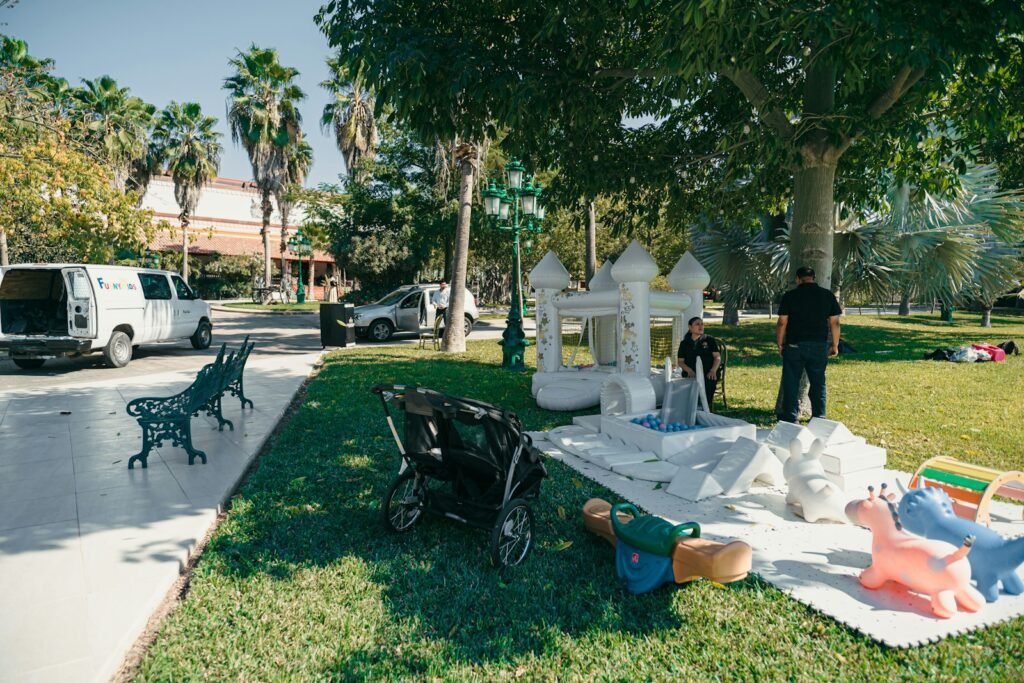
Short answer: how much space and power does a bouncy castle need?
Allow the unit’s footprint plus a clear border all round, which regulator guidance typically puts at 1.2 m or more. You also need a level surface that can be anchored, free space above, and protected power within cable reach of the blower. We confirm exact figures for your unit when you send your measurements.
The figures here come mostly from the UK Health and Safety Executive (HSE), plus a US state labour department and a UAE weather bulletin. They are reference points, not UAE law and not any unit’s spec. The unit’s manual wins.
How much space do you need for a bouncy castle: footprint plus clearance?
The Maryland Department of Labor describes a clearance of typically at least 4 feet, about 1.2 m. With that border on every side, the total area is usually more than double the unit’s floor area.
Worked arithmetic: footprint plus border
These are generic example sizes, not any Book A Bouncy unit. We add 1.2 m to both sides of each dimension, so 2.4 m to length and width.
| Example unit (generic) | Unit floor area | Area with border | Total area needed | Multiple of unit area |
|---|---|---|---|---|
| 3 m x 3 m | 9 m² | 5.4 m x 5.4 m | about 29.2 m² | about 3.2 times |
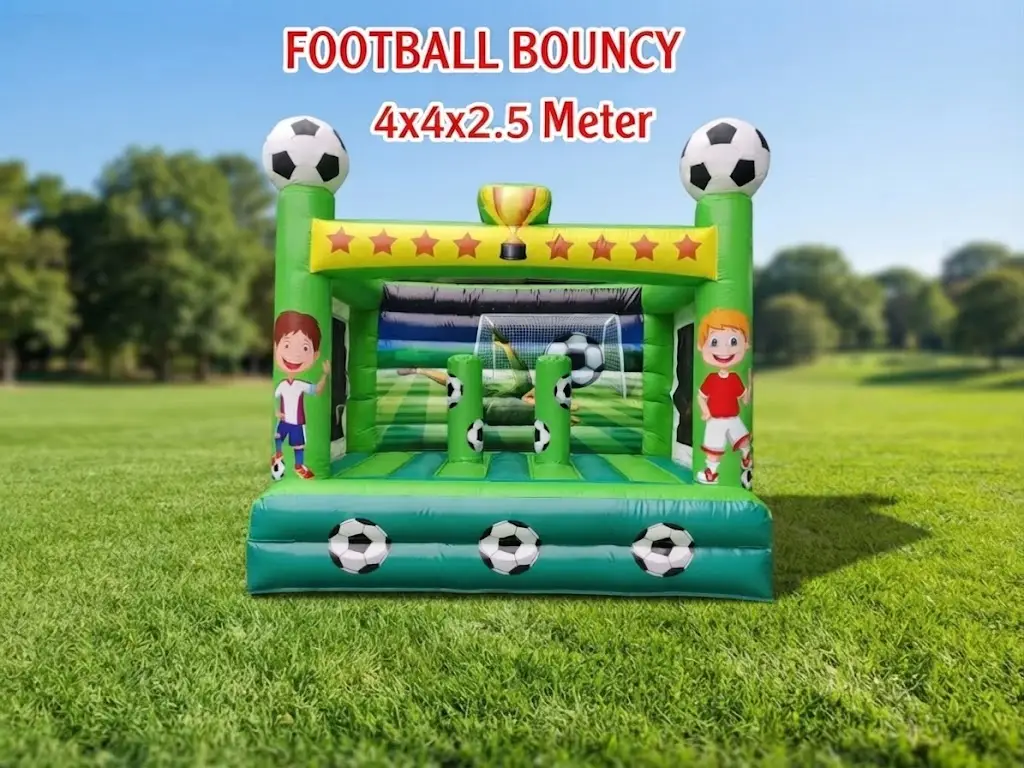
| 4 m x 4 m | 16 m² | 6.4 m x 6.4 m | about 41.0 m² | about 2.6 times |
| 6 m x 5 m | 30 m² | 8.4 m x 7.4 m | about 62.2 m² | about 2.1 times |
Small units need proportionally more spare room, because the border is a fixed width. A pool edge, planter or wall can eat into it.
The border is a minimum, not a target. A unit with a slide or front ramp may need more room on that side. Your unit’s manual sets the figure.
Measure your space in five steps
- Measure the flat, clear floor area in metres, wall to wall. Ignore anything fixed in the way.
- Walk the border. Nothing hard, sharp or breakable should sit within about 1.2 m of the unit’s edge: walls, planters, furniture, play equipment, car bumpers.
- Look up. The HSE tells operators to position the inflatable well away from hazards such as overhead power lines and fences with hazardous projections. Branches, cables and pergola beams count too. Note the lowest one’s height.
- Mark where the blower will sit and where the nearest socket is.
- Photograph the area from two corners, then the surface and the socket.
What ceiling height do you need for an indoor bouncy castle?
Measure to the lowest thing hanging below the ceiling. Lights, beams, air-conditioning ducts, banners and sprinkler heads all count. The unit must inflate fully with clear space above it.
We have no regulator figure for a headroom margin, so we confirm your unit’s inflated height against your measurement before you book.
Unsure what to measure? Message us on WhatsApp or call +971 50 165 8883 with a photo of the space.
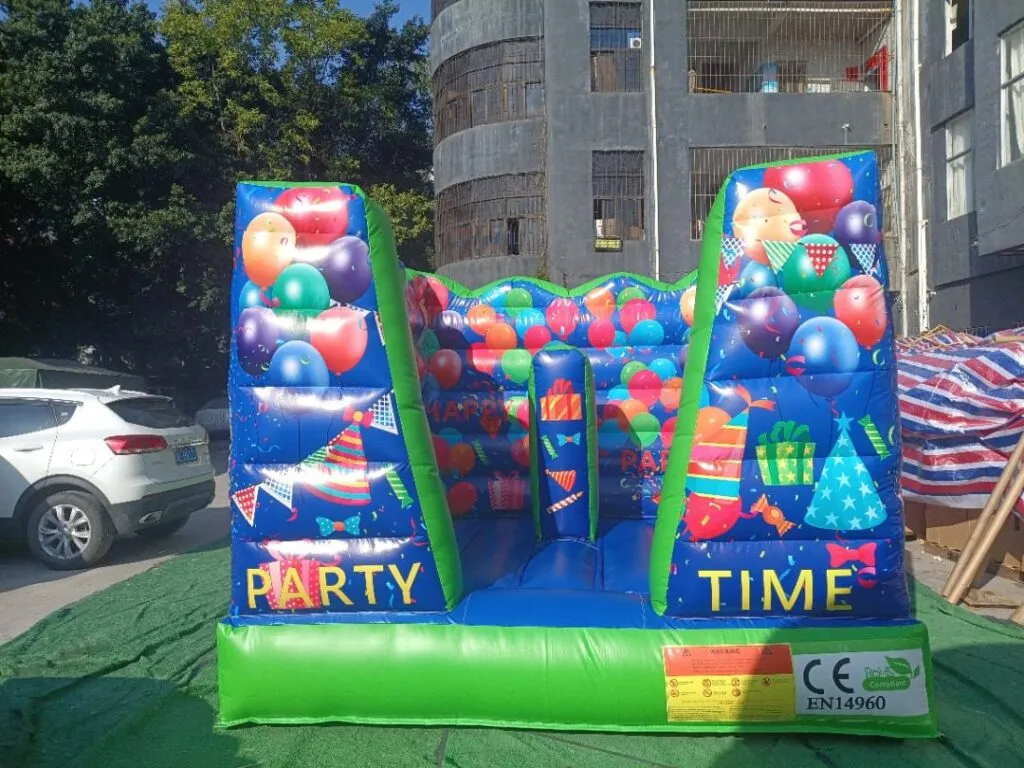
Can a bouncy castle go on grass, tiles, sand or indoors?
Usually yes, but how it is held down changes with the surface. Grass takes ground stakes. Tiles, paving, asphalt and many indoor floors can’t be staked, so guidance moves to weight-based ballast. Sand needs a case-by-case check. Send a photo of the exact spot and we confirm what works for your unit before you book.
| Surface | What changes | What to tell us |
|---|---|---|
| Lawn or garden soil | Stakes are the standard method | Where irrigation lines, pipes or cables run |
| Artificial turf | Depends on what lies beneath it | Whether it sits on soil, sand or concrete |
| Marble, tile or paving | Stakes can’t go in, so weight or other fixings are needed; the floor may need protecting | Floor type, and whether it is slippery when wet |
| Concrete or asphalt | Same as above | Whether it is clean, or oily, gritty or abrasive |
| Sand | Loose sand may not hold stakes well, so the method is decided case by case | Photo, and how deep and loose the sand is |
| Indoor hall or gym | Follow the unit’s manual for indoor anchorage | Floor type, lowest obstruction, doors and lift |
Why hard surfaces are a different job: ballast arithmetic
On grass, the HSE says all anchor points must be used. It specifies metal stakes at least 380 mm long and 16 mm wide, and at least 6 anchor points per inflatable.
Where stakes can’t be used, such as on tarmac, the HSE’s inflatables guidance calls for ballast of at least 163 kg per anchor point. The minimum case: 6 x 163 kg = 978 kg.
That is a regulator floor for a generic unit, not our figure, and your unit may have more than six points. It is why patios and car parks need planning, and why we ask for the surface type before we confirm a booking.
The HSE also says to use a ground sheet on abrasive, oily or dirty ground, and to check the base for debris. Our operator looks over the area on the day. A quick sweep beforehand still helps.
Indoor checklist
- Floor type, and whether it can take a protective sheet
- Lowest obstruction, measured as above
- Width of every door and lift on the route
- Where the sockets are
- Whether the venue or building management allows an inflatable and blower noise
Ask whoever manages the hall, school or compound before you book. We can’t know every building’s house rules.
What power does a bouncy castle need, and do you need a generator?
A bouncy castle needs a continuous supply for the blower its manual specifies. Usually that means a protected socket near the unit, with a generator as the fallback. Guidance expects waterproof-rated connections through a residual current device (RCD). We confirm the blower and power need for your unit.
Sockets, leads and protection
Three points from regulator guidance:
- The HSE says to use the blower specified in the operating manual, and to check the connection tube and blower are firmly attached.
- Argyll and Bute Council says all electrical connections should be IP-rated and run through an RCD.
- The Maryland Department of Labor says extension cord sets should be continuous, with no splice or tap between connectors. Circuit breakers or ground-fault outlets should protect against shock.
So ask two things. Is the socket protected? Is it close enough for one continuous lead that stays off walkways and out of water? In a villa garden, watch for sprinklers, pool decks and wet ground.
Power map: what to note before you message us
- Where is the socket nearest the planned spot, inside or outside?
- Is it outdoor-rated, and is it protected?
- How far is it from the blower position, in metres, along the lead’s route?
- What else runs on that circuit (air conditioning, sound system, popcorn machine, lights)?
Worked arithmetic: does the circuit have room?
Amps equal watts divided by volts. These are example numbers only. They are not any blower of ours and not a statement about your wiring.
A 1,000 W blower on a 230 V supply draws about 4.3 A (1,000 / 230). Two draw about 8.7 A. Add a sound system and a food machine on the same circuit and the total climbs fast. That is why we ask what else shares the circuit.
Do you need a generator? A decision table
| Your situation | Likely answer |
|---|---|
| Protected outdoor socket within one continuous lead of the unit | Use the socket |
| Socket indoors, lead would cross a pool deck, wet lawn or a walkway | Discuss alternatives with us first |
| Shared circuit already carrying heavy loads | Different circuit, or generator |
| Park, open ground or a car park with no supply | Generator |
A generator solves the socket problem only. The blower must still match the manual, and the supply still needs protection. Tell us your situation in your first message and we confirm the power arrangement for your booking.
Send your details through the booking form and add your socket photo.
Will the unit get through your gate, lift or stairs?
Inflatables arrive deflated and are carried in, so the narrowest point on the route decides. Measure that width, count any steps, and photograph the route. We check it against your unit’s packed size once you send the details.
Route checklist for villas, towers and podium gardens:
- Gate or side-passage width at the narrowest point
- Tight corners, low branches or pergolas along the route
- Steps or ramps, and how many
- Lift door width, and whether the lift needs booking
- Where a vehicle can stop to unload
- Whether building or community management needs notice of a delivery
When does a bouncy castle not work on your site?
It doesn’t work without enough clear area, a level surface, protected power, a workable route in, or calm enough wind. When one fails, we’d tell you to change the spot, the unit or the date. That saves a wasted booking.
- Wind. The HSE says no inflatable should be used in winds above 24 mph (38 km/h), Force 5 on the Beaufort scale. Some units have a lower limit. Phone weather apps don’t capture local wind. The National Center of Meteorology’s bulletin dated 10 November 2026 forecast winds of 15 to 30 km/h, gusts of 45 to 60 km/h on some days that week, and blowing dust. Those gusts are above the HSE limit.
- Not enough clear area. Use a smaller unit or a different spot. Don’t squeeze it in.
- Overhead hazards. Power lines, low branches and projecting fences rule a spot out until managed.
- Sloping or unstable ground. The Maryland guidance asks for a level, stable area free of sharp objects and debris.
- No protected power within reach and no room for a generator.
- Access. If the unit can’t reach the spot, the date doesn’t matter.
- Venue rules. Some buildings and compounds restrict deliveries, inflatables or noise.
If rain, strong wind or extreme heat stops your event, we move the booking to a new date at no extra cost. Details are in our rental FAQs.
Seven measuring mistakes that cause problems on the day
- Measuring the lawn but not the gate.
- Measuring the floor but not the lowest overhead obstruction.
- Forgetting the border, so the unit touches a wall.
- Counting a spot under a tree, where branches reach the unit.
- Forgetting where the blower and lead go.
- Assuming any outdoor socket is safe, without checking protection or circuit.
- Guessing the surface: artificial turf over concrete behaves like concrete.
Send us your measurements
No drawing needed. A WhatsApp message with these details lets us tell you what fits:
- Emirate, area and type of space (villa garden, hall, indoor venue)
- Free area, length and width in metres
- Surface type, with a photo
- Height of the lowest overhead obstruction
- Nearest socket, with a photo, and the distance to the planned spot
- The route in: narrowest point and any steps or lifts
- Event date, and how many children and roughly what ages
We reply with what fits, the anchoring approach and the power arrangement.
Want to see what we have first? Browse small bouncy castles for hire. Larger layouts, such as combos and inflatable slides, may need more room.
Planning a party? Start with our kids birthday party page. Then read our guides on safety rules, what affects the price and how far ahead to book.
Ready to check your space? WhatsApp or call +971 50 165 8883, or use the booking form.
Frequently asked questions
Can a bouncy castle go indoors in a hall or apartment building?
Often yes, if the unit suits indoor use and the room allows it. The HSE notes that indoor anchorage follows the manufacturer’s manual. You need a suitable floor, clear space above the inflated height, wide enough doors and lifts, and venue permission. Send photos and measurements and we confirm.
Is an operator included, and do I need to set anything up?
An operator or attendant is included on all bookings, so you don’t position or anchor the unit yourself. We need information from you before the day: the spot, the surface, the socket and the access route.
What if it is too windy on the day?
If rain, strong wind or extreme heat stops the event, we move the booking to a new date at no extra cost. UK HSE guidance sets a ceiling of 38 km/h for any inflatable, and some units have a lower limit. So wind is judged on the day, not guessed.
What if my space is too small?
Tell us the free length and width and we say what fits. That may be a smaller unit, or a different spot with fewer obstructions. We would rather tell you before you book than squeeze a unit into a space without the clear border.
Can I run a lead from inside the house?
Possibly. Guidance expects waterproof-rated connections protected by an RCD, and leads should be continuous with no joins. A lead across a doorway, walkway or wet lawn creates trip and shock risks. Send a photo of the socket and the route and we advise on the safest arrangement.
Sources
- All anchor points must be used (hse.gov.uk)
- Inflatables guidance (hse.gov.uk)
- Position the inflatable well away from hazards (hse.gov.uk)
- All electrical connections should be IP-rated and run through an RCD (argyll-bute.gov.uk)
- Typically at least 4 feet (labor.md.gov)
- Bulletin dated 10 November 2026 (assets.ncm.gov.ae)
Last updated: 14 November 2026
Book A Bouncy, Tip Top Entertainment Services LLC, City Avenue Building, Office 404, Port Saeed, Deira, Dubai. WhatsApp or call +971 50 165 8883.